Something Prior to Intelligence
There is a moment I keep returning to.
It happens in the small pause before I begin a prompt, before I type the first word of a question I’m about to hand off to a model. In that pause, I can feel the answer already waiting on the other side. Faster than I could think it. More comprehensive than I could produce alone. None of the friction that used to be the price of serious thinking. And yet that friction is what I keep coming back to.
The friction, I’m realizing, wasn’t the problem.
The friction was the point.
For most of my career, I worked as a strategy consultant. The value I delivered was pattern recognition under pressure: walking into complex, high-stakes situations and seeing quickly what others had missed. Clients paid well for that speed and clarity. Advisory engagements that ran into seven figures were not unusual.
Last weekend, I sat down with Anthropic’s new model and produced a red-team analysis of a complex product I’m building. In under two hours, it surfaced structural weaknesses that would once have taken me four or five weeks to find. This was the kind of work clients had paid seven figures to receive.
That comparison made the shift undeniable.
I sat with that for a long time.
This was not a crisis. It was recognition: the work I built my career on is probably cooked. Not tomorrow. But the trajectory is unmistakable.
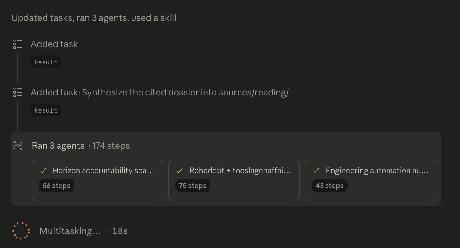
I reached for my phone and sent my friend Chris a screenshot.
Chris and I met studying AI safety. We finished the same program with the same certificate and spent months worrying about the same risks. He is careful, rigorous, genuinely thoughtful about what’s coming. One of the people I trust most on this subject.
Within seconds, his response arrived. Not a reaction to the screenshot, a photograph.
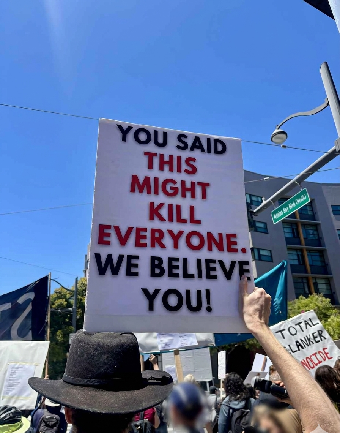
Chris was standing outside OpenAI’s San Francisco offices, part of a protest rally. The crowd, he told me a moment later, was already moving to Anthropic.
I texted something shallow. He didn’t take the bait.
We hadn’t spoken in over a year. When we finally called, it felt effortless, more laughter than I expected, the old rhythm finding itself quickly. Before he hung up, Chris said something I’ve been carrying since.
He told me he had watched me change. He named it clearly, without judgment, and then acknowledged that he had watched it from a distance, continuing to avoid the same move himself. Not intentionally, he said. Not stubbornly. A genuine inability to see the path.
He was right. Something had changed.
I want to describe it precisely because I don’t think it is what people expect when they hear the word “transformation” in the context of artificial intelligence.
I did not overcome a fear. I did not swap my methods for new ones. What shifted was the purpose: I stopped using these tools to produce outputs and started using them to explore problems. The distinction sounds subtle. A tool answers the question you ask. A partner helps you discover whether you are asking the right question at all.
Working this way requires something specific: you have to bring complete context, genuine uncertainty, the actual stakes. You have to resist arriving already knowing the answer and using the model to justify it. You have to stay open enough to be surprised.
That discipline, bringing better questions, staying inside uncertainty long enough for the real problem to surface, is not something the tools can provide. The quality of what a model produces is a direct function of what you bring to it: the precision of your context, the honesty of your uncertainty, the sharpness of the question you are willing to sit inside long enough to fully form.
This means the most valuable thing I do now happens before the first prompt.
I want to take Chris’s position seriously because it deserves that.
The people who spend real time studying AI risk are not being naive or obstructionist. The history of powerful technologies being deployed faster than the institutions that govern them warrants genuine concern. The coordination failures, the misaligned incentives, the gaps between what developers can build and what societies can absorb, these are documented rigorously in research that Chris and I both read during our program. His discomfort is not ignorance. It is a position derived from intellectual seriousness.
I find myself wondering whether his position is protecting something or simply delaying engagement until engagement becomes impossible.
I have watched this pattern in organizations undergoing profound change. The people who hold back longest, waiting for clarity, waiting for better conditions, waiting to fully understand before committing to movement, frequently find themselves neither informed nor prepared when they finally have no choice. Waiting is not the same as safety. Sometimes it is a more comfortable version of the same risk.
I asked Chris one question before we hung up: What if the safest thing you could do is give yourself permission to explore it?
He went quiet. Then he asked if we could talk more often.
I’m taking that as a beginning.
Almost every conversation I have about AI arrives eventually at the same place, though people approach it from different directions. The person asking about model capabilities is asking about relevance. The person asking about job displacement is asking about dignity. The person asking about safety is asking about trust.
They think they’re asking about artificial intelligence. They are asking about their future.
I used to meet these questions with analysis: adoption curves, capability benchmarks, investment theses. I thought I was being helpful by giving people context. I was offering maps when what they needed was company inside uncertainty.
Now I ask a simpler question back: How are you using it?
The answer reveals more than people intend. It locates them, where they stand in relation to the thing they are asking about, what they have already tried and abandoned, what they are protecting. It tells me whether the conversation has permission to go somewhere real.
Chris’s honest answer would be: not yet. Whatever is holding him there, fear, judgment, conviction, or some combination of the three, is grounded in risks he has spent years taking seriously.
His hesitation carries a particular cost: he understands the risks better than most people, but he is trying to judge the experience without entering it.
That hesitation is pointing at something real and worth taking seriously. It is not irrational, and I do not want to dismiss it as mere resistance. But hesitation, held long enough without movement, becomes its own kind of position, one that feels like safety because it involves no risk and therefore accumulates no learning.
The model used to produce my red-team analysis was impressive. It was not curious about my problem. It had no stake in whether I succeeded or failed. It could not be surprised by the implications of what it found because it does not sit with implications. It synthesized everything I gave it and returned a structure I could not have produced on my own. But the significance of what it found, the stakes, the surprise, what should happen next, still belonged to me. That is exactly why the human part still matters. That is the limit and the strength of it.
What it handed back was always a function of what I brought to it.
That last part matters more than it sounds.
The consultants, advisors, and strategists who will matter in five years are not the ones who held their methods intact or the ones who abandoned them entirely. They are the people who stayed curious long enough to find out what they were actually building, who understood that the discipline of arriving at the right question cannot be outsourced.
Chris spent years studying what could go wrong when powerful systems outpace the humans governing them. That work was not wasted. If anything, the people who took those questions seriously are exactly the ones whose judgment matters most as these tools become embedded in everything.
What Chris and I are really arguing about, even in the calls where we are not arguing at all, is whether intelligence, once externalized, enhances human capacity or substitutes for it. That is a real question. It deserves serious treatment. And I do not think it is answerable from a distance.
The willingness to stay inside the question, to not know, to hold the ambiguity, to let the problem remain unresolved long enough to reveal its actual form, is not something models have. Not yet. Possibly not ever. It is the throughline that holds the rest of this together.
Right now, it is the most valuable thing a thinking person can cultivate. And it is exactly what we risk trading away if we reach for the answer before the question is fully formed.
I don’t know where my friendship with Chris goes from here. Whether his resolve to resist and my willingness to explore will pull us apart, or whether continued conversation will change something in both of us, I genuinely cannot say. What I do know is that the question remains open and that I am trying to stay within it without forcing an answer.